
God
beauty belongs to
The spiritual decline of western art & the Majesty Project’s call for restoration
The decline of Western art reflects a broader spiritual decline. As culture has turned from God, art has often turned from beauty, truth, and excellence toward self-expression and relativism.
The Majesty Project exists to help restore art to its rightful purpose: glorifying God, serving others, and revealing His majesty through beauty, craftsmanship, and excellence.
in the beginning
Beauty, Order, and Creation belong to God
The Bible reveals God as the Master Creator who delights in beauty, order, and excellence. From creation to the Tabernacle and the New Jerusalem, Scripture shows that beauty reflects His character and points people to His glory. Art, at its best, is a reflection of the Creator—meant to inspire worship, reveal truth, and draw people closer to God.
The Renaissance: Art as a Reflection of God’s Glory
During the Renaissance (14th–17th century), art was seen as a sacred calling, a way to reflect the majesty of God’s creation. Artists such as Leonardo da Vinci, Michelangelo, and Raphael sought not just to imitate nature but to reveal the divine order within it. Their work displayed harmony, precision, and beauty—values deeply rooted in the belief that creation itself was imbued with God’s design.

Raphael's Disputation of the Holy Sacrement

The Enlightenment and Romanticism: Man Replaces God
During the Enlightenment, Western art gradually shifted from glorifying God to emphasizing human reason, emotion, and individual expression. Artists such as Caspar David Friedrich and William Blake explored spirituality outside the framework of Christianity, reflecting this cultural change. While artistic skill remained, the focus moved away from biblical truth and toward the self—a turning point that marked art's departure from its divine purpose.
Friedrich's Abbey In the Oakwood
Modernism: The Rejection of Truth and Beauty
By the late 19th and early 20th centuries, many modern art movements had shifted away from objective beauty and order. Artists such as Pablo Picasso and Georges Braque (Cubism), Marcel Duchamp and Kurt Schwitters (Dadaism), Salvador Dalí and René Magritte (Surrealism), and Jackson Pollock and Mark Rothko (Abstract Expressionism) explored new approaches that increasingly emphasized abstraction, irrationality, and personal expression over traditional realism and craftsmanship.
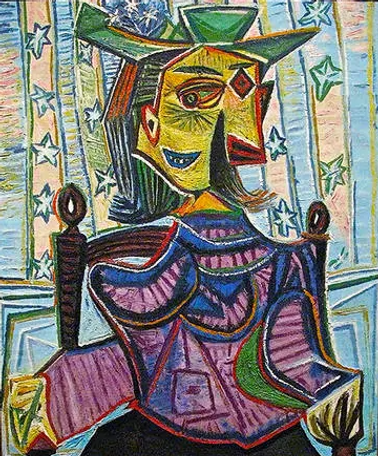
Picasso's Dora Maar in an Armchair
Postmodernism: The Worship of the Self
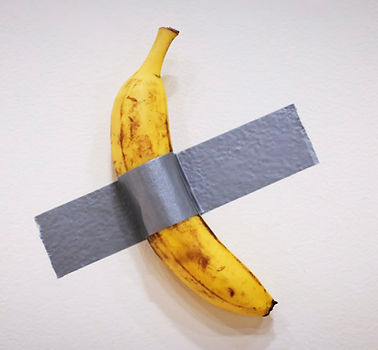
By the late 20th and 21st centuries, much of the contemporary art world had embraced relativism, placing greater emphasis on concept, personal interpretation, and provocation than on traditional beauty and craftsmanship. Works such as Maurizio Cattelan's Comedian and Jens Haaning's Take the Money and Run illustrate this shift toward conceptual art.
Maurizio Cattelan’s Comedian

Jens Haaning’s Take the Money and Run
The Majesty Project: Restoring Art to Its Divine Purpose
The Majesty Project exists to help people see and savor the majesty of God through beautiful, Christ-centered artwork. We believe art is a sacred calling that can proclaim God's glory, reflect His beauty, and inspire worship, hope, and reverence.
By equipping Christian artists and placing original artwork in communities across the country, we seek to restore beauty, pursue excellence, and reveal God's character through visual art. Our prayer is that every piece points beyond itself to the Creator, bringing light, hope, and the majesty of God to those who experience it.

Conclusion: A Call to Christian Artists
Western art’s decline mirrors the spiritual decline of the culture. As faith in God eroded, so did art’s pursuit of beauty, excellence, and truth. But this collapse is not irreversible. Just as the Renaissance was a period of renewal in the wake of darkness, The Majesty Project calls on Christian artists to bring about a new artistic revival—one that glorifies God and restores the divine purpose of art.
It is time for Christian artists to reject the culture of mediocrity, relativism, and self-worship and instead create with purpose, excellence, and reverence. Art should once again declare the majesty of God and transform lives through its truth.